
Spinal Stenosis Treatment Amsterdam: Stay Active Without Surgery
Spinal stenosis is one of those diagnoses that can feel like a sentence — as though the narrowing in your spine is fixed, irreversible, and destined to erode your independence. In reality, the research tells a more nuanced story. Structural narrowing of the spinal canal does not always correlate cleanly with how much pain someone feels or how far they can walk. What matters just as much — sometimes more — is how the nervous system and surrounding tissues are responding to that narrowing. That distinction is where effective, non-surgical care begins.
What Spinal Stenosis Actually Is
Spinal stenosis describes a reduction in the space available for the spinal cord or nerve roots within the vertebral canal. The two most clinically relevant regions are the lumbar spine (lower back) and the cervical spine (neck). In the lumbar region, it is the nerve roots supplying the legs that come under pressure. In the cervical region, compression can affect both the nerve roots travelling to the arms and, in more significant cases, the spinal cord itself.
The narrowing is usually the cumulative result of age-related changes: disc height loss, facet joint hypertrophy, ligamentum flavum thickening, and the formation of osteophytes (bony spurs). These changes develop slowly, which partly explains why many people with clear stenosis on MRI report minimal or intermittent symptoms. The canal has narrowed, but the nervous system has partially adapted. Our job is to support and extend that adaptation — to find what the system needs in order to keep functioning well.
Recognising the Symptoms: Lumbar and Cervical
Lumbar Spinal Stenosis
The hallmark presentation of lumbar stenosis is neurogenic claudication — leg pain, heaviness, cramping, or weakness that builds with walking or sustained standing and resolves when you bend forward, sit down, or lean over a shopping trolley. This pattern exists because lumbar flexion increases the cross-sectional area of the spinal canal, temporarily decompressing the nerve roots. Extension does the opposite.
This is also why many people with lumbar stenosis find cycling considerably more comfortable than walking. On a bike, the spine is held in slight flexion; the provocative extension load is removed. If you recognise this pattern in yourself, it is a useful clinical signal — and it also points directly toward which movements and positions should anchor your rehabilitation.
Other lumbar stenosis symptoms can include: numbness or tingling radiating into one or both legs, a feeling that the legs are giving way, and in some cases bladder or bowel changes. The latter warrants urgent medical assessment.
Cervical Spinal Stenosis
Cervical stenosis tends to present with neck pain, stiffness, and pain or altered sensation radiating into one or both arms. When the stenosis is significant enough to compress the spinal cord (a condition called cervical myelopathy), symptoms can include difficulty with fine motor tasks — buttoning a shirt, typing — as well as balance disturbance and an unusual gait. Weakness or clumsiness in the hands alongside any gait change should prompt prompt clinical assessment rather than a wait-and-see approach.
Early physiotherapy for cervical stenosis focuses on maintaining the mobility and neuromuscular control of the neck and shoulder girdle, reducing the compressive forces through posture retraining, and addressing the broader nervous-system sensitivity that amplifies symptoms over time.
Finding the Root: How We Assess Spinal Stenosis at Alter
A scan finding of stenosis is a piece of information, not a complete explanation. Our first task is to understand why your system is symptomatic right now. That means identifying the primary restriction — whether it is a loss of spinal segmental mobility, a missing motor pattern, an overactive protective response in the deep paraspinal muscles, or a sensitised nervous system that has learned to signal danger before genuine tissue damage occurs.
During assessment, we will look at how you move through your full lumbar or cervical range, test the load-tolerance of individual segments, assess neurological function in the limbs, and evaluate how the deep stabilising muscles of the spine are coordinating. We pay close attention to what changes immediately with a specific movement correction or manual input. If repositioning your pelvis adds fifteen metres to your comfortable walking distance during the assessment, that tells us something precise about where to direct treatment.
This is not a soft, intuitive process. It is systematic clinical reasoning that uses measurable outcomes — range of motion, symptom reproduction and relief, neural provocation tests — to confirm or revise our hypothesis about what is maintaining your symptoms.
Non-Surgical Treatment: What We Do and Why
Flexion-Based and Directional Exercise
For lumbar stenosis, exercises that load the spine in flexion — posterior pelvic tilts, knee-to-chest stretches, seated forward leans, and quadruped positions — can provide reliable symptom relief by temporarily enlarging the available canal space and reducing nerve root irritation. These are not generic “back exercises”; they are chosen because they match your directional preference identified during assessment.
Aquatic physiotherapy deserves a specific mention. Water reduces compressive load through buoyancy, allows greater movement with less pain, and makes it possible to sustain aerobic activity that would be interrupted by neurogenic claudication on land. For patients whose walking tolerance is severely limited, hydrotherapy can be an important bridge back to land-based activity.
Core and Neuromuscular Retraining
A well-coordinated deep stabilising system — particularly the transversus abdominis, multifidus, and pelvic floor — reduces the compressive and shear forces transmitted through each spinal segment with every step. The goal is not simply “core strength” in the generic sense. It is the timing and coordination of these muscles: their ability to anticipate load and stiffen the spine appropriately before movement happens.
We use real-time feedback during exercise — observing movement quality, feeling motor control under load, and sometimes using simple biofeedback tools — to train this coordination accurately. Patients who develop good deep stability consistently report increases in walking tolerance and reductions in the frequency of symptom flares.
Manual Therapy and Acupuncture
Joint mobilisation of the facet joints and thoracolumbar fascia can improve segmental mobility, reduce protective muscle guarding, and modulate pain through mechanoreceptor input into the nervous system. We are not trying to “fix” the stenosis manually — structural narrowing does not reverse with hands-on work — but we can meaningfully alter the system’s sensitivity and the quality of movement around the affected segments.
Japanese acupuncture, as we apply it, uses very fine needles at low stimulus intensity to influence the autonomic nervous system and reduce central sensitisation — the state in which the nervous system’s alarm system has become disproportionately reactive. For patients with longstanding stenosis-related pain, this down-regulation of nervous system output can be a useful adjunct that makes exercise and movement retraining more accessible. It is one input among several, chosen when the clinical picture suggests the nervous system is a primary driver of symptom severity.
If your situation resembles a herniated disc, where nerve irritation rather than canal narrowing is the dominant mechanism, many of the same principles apply — directional loading, neural mobilisation, and reducing systemic sensitisation — though the specific directional bias may differ significantly.
Self-Care and Exercises You Can Start Today
These are general strategies for lumbar stenosis. They are a starting point, not a substitute for an individual assessment.
- Posterior pelvic tilt (lying): Lie on your back with knees bent. Gently flatten your lower back against the floor by tilting your pelvis backward. Hold for five seconds and repeat ten times. This is the foundational decompression movement for most lumbar stenosis presentations.
- Knee-to-chest stretch: From the same position, draw both knees slowly toward your chest, hold for twenty to thirty seconds, and release. Do this two to three times. Stop if symptoms increase into your legs.
- Seated forward lean: Sit in a chair and slowly lean forward, resting your forearms on your thighs. Hold for thirty to sixty seconds. Many people find this position allows neurogenic claudication symptoms to settle during a walk break.
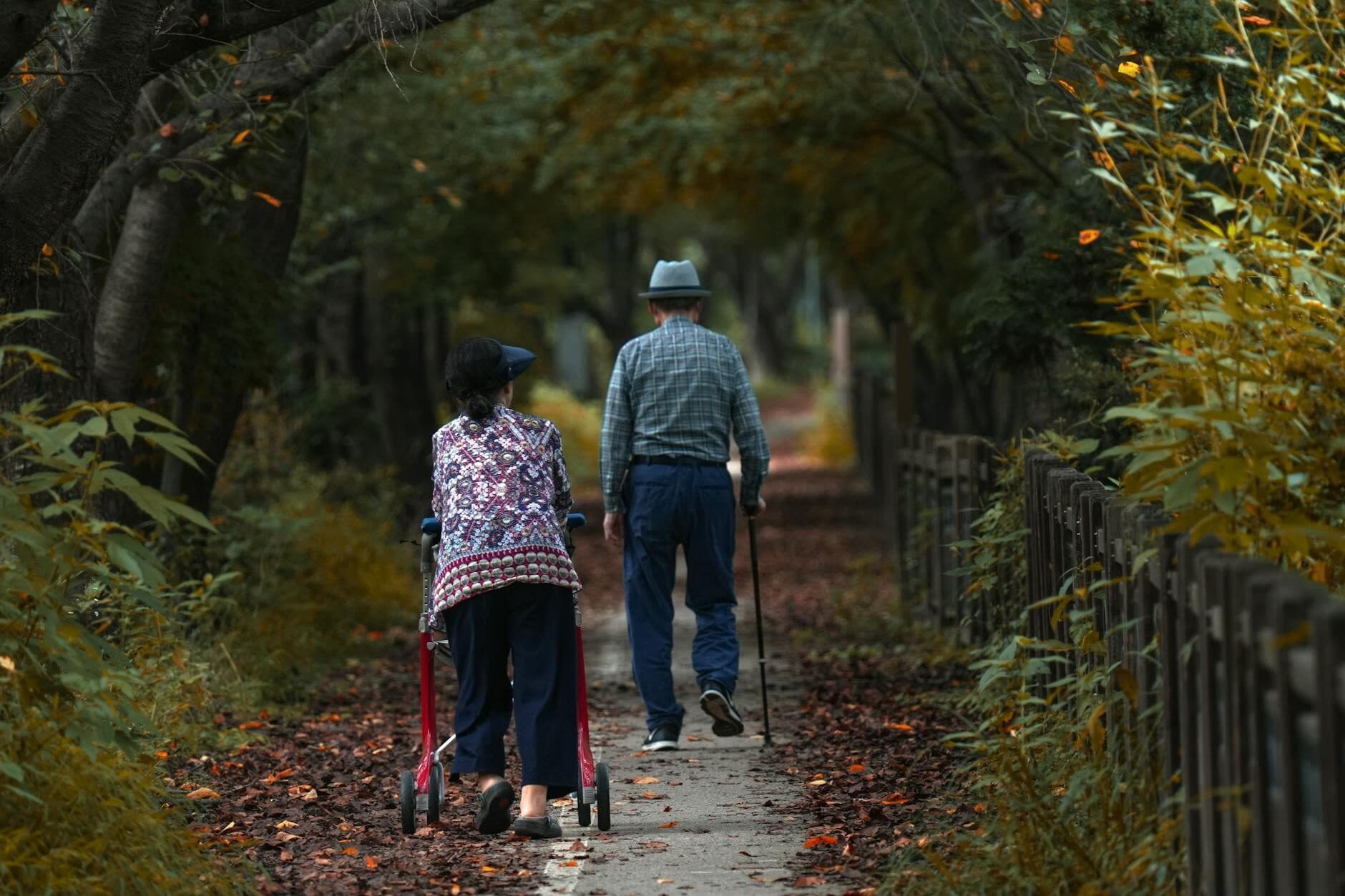
- Walking with a slight forward lean: Using a walking frame, shopping trolley, or trekking poles encourages mild spinal flexion during walking and can extend comfortable walking distance meaningfully.
- Cycling: A stationary or regular bike ridden in an upright-to-slightly-forward position is excellent aerobic conditioning for most people with lumbar stenosis. Aim for consistency over intensity.
- Pacing: Rather than walking to the point of significant leg symptoms and then stopping, experiment with shorter walking intervals with forward-lean rest breaks. This allows greater total daily distance without provoking as strong a sensitisation response.
For shoulder or upper limb symptoms alongside neck findings, the principles of load management and neural mobilisation are similar to those used in frozen shoulder rehabilitation — graduated, pain-guided movement restoration with attention to the nervous system’s tolerance.
When to Come In
Self-management strategies are valuable, but some presentations warrant professional assessment sooner rather than later:
- Leg symptoms that are worsening rather than stable or improving
- Any bladder or bowel changes alongside back or leg symptoms
- Cervical stenosis with hand clumsiness, balance difficulty, or gait changes
- Symptoms that have significantly restricted your daily activity for more than six to eight weeks without improvement
- A stenosis diagnosis but no clear, personalised rehabilitation plan
Surgery remains an option for a minority of patients with severe or progressive neurological deficit. For most people, however, a well-structured non-surgical programme significantly improves function, extends walking tolerance, and reduces pain — often durably. The evidence base for conservative management of lumbar stenosis is robust, and surgery does not reliably outperform it in patients without severe neurological compromise.
Frequently Asked Questions
Can spinal stenosis be cured without surgery?
Structural narrowing of the canal does not reverse without surgical intervention. What conservative treatment can do — and does effectively in many cases — is reduce the nervous system’s sensitivity to that narrowing, improve the capacity of surrounding muscles to offload the affected segments, and restore enough functional movement that symptoms become manageable and activity levels increase significantly. For many patients, this is a clinically meaningful outcome.
Is it safe to exercise with spinal stenosis?
Generally yes, with appropriate direction. The key is identifying which movements and positions are beneficial for your specific presentation. Flexion-biased activity tends to be well-tolerated in lumbar stenosis; sustained extension and heavy axial loading are usually not. An individualised assessment allows us to map these boundaries accurately for you.
How long does treatment take?
Most patients begin to notice measurable improvement in walking tolerance and pain levels within four to eight weeks of consistent, well-directed rehabilitation. Long-term management — maintaining the strength, movement habits, and lifestyle modifications that keep symptoms controlled — is ongoing. The goal is independence: understanding your body well enough to self-manage effectively between and after clinical input.
Does acupuncture help spinal stenosis?
Acupuncture, as an input to the nervous system, can help modulate pain sensitivity and reduce the protective muscle tension that often amplifies stenosis symptoms. It is not a structural treatment, but when the nervous system is significantly sensitised, reducing that reactivity can make movement and exercise rehabilitation more accessible and effective. We use it when the clinical picture suggests it will add measurable value.
Spinal stenosis does not have to define the boundaries of your life. With the right assessment, a precise understanding of what is driving your symptoms, and a programme built around restoring what your system has lost, staying active — and staying out of the operating theatre — is a realistic goal for the majority of people we see.
If you are ready to understand what is actually maintaining your symptoms and what can change, book a consultation with Hidekazu. We will find the restriction, apply the smallest effective input, and measure whether it works — in the same session.