
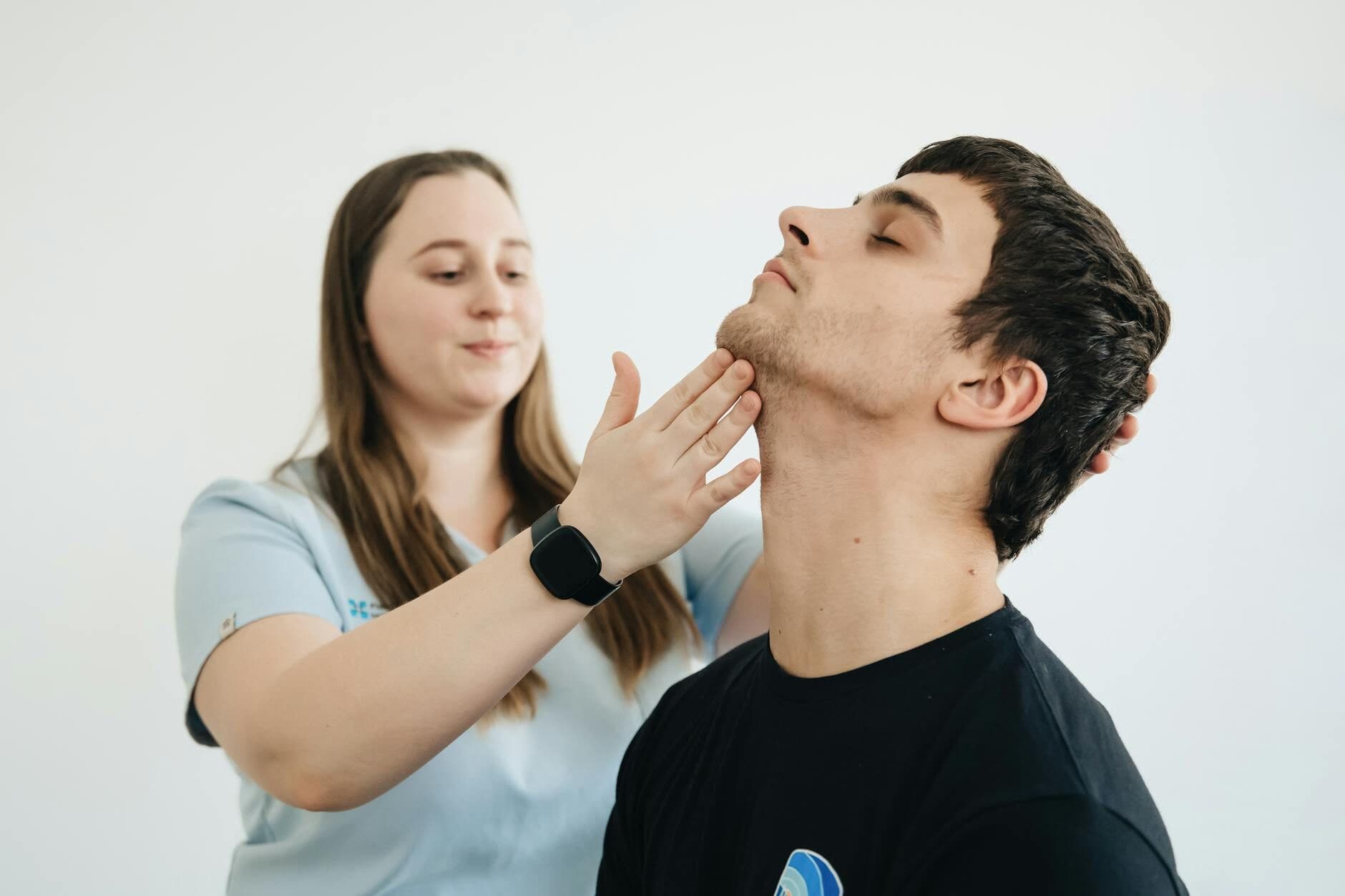
TMJ and Jaw Pain Treatment Amsterdam: Physiotherapy and Acupuncture
TMJ Disorder: Jaw Pain That Affects Your Whole Body
The temporomandibular joint — the hinge where your lower jaw meets your skull, just in front of each ear — is one of the most mechanically complex joints in the body. It combines a gliding motion and a rotational motion in the same movement, and it does so hundreds of times a day every time you speak, eat, or swallow. When something disrupts its finely tuned mechanics, the effects rarely stay local. Jaw pain, persistent headaches, ear fullness, neck tension, tinnitus, and disturbed sleep can all trace a line back to a TMJ that is no longer moving the way the nervous system expects it to.
At Alter Physio & Acupuncture in Amsterdam Zuid, we approach TMJ disorder the way we approach every complex presentation: the symptom — jaw pain, clicking, restricted opening — is the output of a system looking for equilibrium. Our job is to find the primary restriction that is preventing that equilibrium, apply a precise and minimal input to remove it, and then confirm the change is real and measurable before the session ends. The tool we use to do that — a mobilisation, a fine needle, a breath cue, a targeted exercise — is chosen by the reasoning, not announced in advance.
Common Causes of TMJ Disorder
Bruxism: The Stress Load the Jaw Carries at Night
Bruxism — grinding or clenching the teeth, most often during sleep — is among the most frequent drivers of TMJ disorder. The forces generated during nocturnal clenching can be several times greater than those produced during normal chewing. Over weeks and months, that repeated overload sensitises the joint lining, compresses the articular disc, and creates chronically shortened, painful jaw muscles — particularly the masseter, temporalis, and medial pterygoid.
What makes bruxism clinically interesting is that it is rarely purely a dental issue. Current evidence positions it as a central nervous system behaviour, tightly coupled with stress arousal, sleep microarchitecture, and autonomic regulation. Addressing only the teeth with a splint — while useful for protecting enamel — does not resolve the underlying motor pattern. Treatment that includes the nervous system, the cervical spine, and the muscular load tends to produce more durable results.
Forward Head Posture and Cervical Spine Involvement
The upper cervical spine and the jaw share neurological real estate in a way that makes them functionally inseparable. The trigeminal nerve — the primary sensory nerve of the face and jaw — and the upper cervical afferents converge in the trigeminal nucleus caudalis in the brainstem. This means that restricted movement at C1–C3 can directly increase sensitivity and perceived pain in the jaw, and vice versa.
Forward head posture, so common in desk workers and screen users, increases the mechanical load on the suboccipital muscles and alters the resting position of the mandible. The jaw is then working from a mechanically disadvantaged start position every time it opens and closes. Correcting this posture is not cosmetic — it is a functional necessity for lasting TMJ recovery. This is also why people with TMJ disorder so frequently also report neck stiffness and headaches or migraines: the same restricted input is generating multiple outputs simultaneously.
Articular Disc Displacement
Inside the TMJ sits a fibrocartilaginous disc that acts as a cushion and guides smooth movement as the jaw opens and closes. When the disc shifts out of its ideal position — most often anteriorly — the result is a click or pop as the jaw opens (the condyle briefly recaptures the disc), and sometimes a second click on closing. If the disc remains displaced without recapture, the jaw may lock, and opening becomes sharply restricted and painful.
Early-stage disc displacement often responds well to conservative physiotherapy: specific mobilisation techniques can restore normal disc mechanics, reduce inflammatory load on the joint, and allow the surrounding muscles to decompress. Later-stage or longstanding displacement requires careful assessment to determine what is achievable without surgical input.
Systemic and Autonomic Contributors
It is worth noting that TMJ disorder is more prevalent in people experiencing chronic stress, anxiety, poor sleep, or autonomic dysregulation. When the nervous system is running in a prolonged threat or high-arousal state, muscle tone throughout the body rises — and the jaw is a primary target. If you recognise this pattern in yourself, it may be worth reading about how we approach burnout recovery, where similar autonomic and musculoskeletal threads are woven together.
How We Find and Resolve the Root
A thorough assessment is where effective TMJ treatment begins. We evaluate mouth-opening range (normal is typically 40–55 mm between the front teeth), the quality and symmetry of jaw movement, cervical spine mobility, muscular tenderness patterns, and postural alignment. We also ask about sleep quality, stress levels, headache patterns, and ear symptoms, because these give us important information about the wider system we are working with.
From that assessment, we identify the primary restriction — the missing movement or the sensitised neural pathway that is generating the most downstream noise — and we work on that first. The response to treatment is assessed in real time: if mouth opening improves measurably, if pain on palpation reduces, if movement becomes more symmetric, we know the input was appropriate. If it does not change, we reassess rather than repeat.
Joint Mobilisation
Graded mobilisation of the TMJ itself — applied gently through the joint capsule — can restore glide and rotation mechanics, reduce the compressive load on the disc, and directly decrease pain via well-documented neurophysiological mechanisms (mechanoreceptor activation, descending pain inhibition). Mobilisation of the upper cervical spine is often performed in the same session, given the shared neural territory described above.
Soft Tissue Work and Dry Needling
The masseter and temporalis muscles are accessible from outside the mouth; the pterygoids require intraoral or near-intraoral technique. Precise soft tissue release to these muscles can produce rapid reductions in resting jaw tension and an immediate increase in pain-free opening range. Dry needling — a fine-needle technique applied to myofascial trigger points within these muscles — can achieve similar or complementary effects, particularly in muscles that are too guarded or sensitised for sustained manual pressure.
Japanese Acupuncture for TMJ Pain and Bruxism
Japanese-style acupuncture, as practised at Alter, uses exceptionally fine needles with minimal stimulation, prioritising the precision and location of each point over the intensity of the sensation. For TMJ disorder, needling can be directed at the local jaw muscles to reduce their resting tone, at distal points associated with the trigeminal and vagal pathways to down-regulate the central sensitisation component, and at points that support autonomic balance — relevant where bruxism and stress arousal are intertwined. Patients frequently notice a measurable increase in jaw opening or a reduction in local tenderness immediately after needling, which serves as an objective marker that the intervention reached the target system.
If ear fullness or tinnitus accompanies your jaw symptoms — a common combination — you may also find our page on dizziness and tinnitus treatment relevant, as the eustachian tube and middle ear muscles share anatomical neighbours with the TMJ.
Self-Care and Simple Exercises You Can Do Now
The following can support your recovery between sessions, but they are not a substitute for a proper assessment. If any exercise increases your pain, stop and consult a clinician.
- Tongue-on-palate rest position: The resting position for your jaw should have your lips lightly together, teeth slightly apart, and the tip of your tongue resting gently on the roof of your mouth just behind your front teeth. This reduces continuous low-level clenching that many people are unaware they do. Practice returning to this position throughout the day.
- Controlled jaw opening: Place your tongue on the roof of your mouth (as above) and open your mouth slowly straight downward, keeping your chin from jutting forward. Aim for ten slow repetitions, twice a day. This trains the jaw to open on the hinge axis before it glides, which is the correct sequence and the one most often disrupted in TMJ disorder.
- Suboccipital release: Lying on your back with a small rolled towel under the base of your skull, allow the weight of your head to gently decompress the upper cervical joints. Hold for two to three minutes. This is not a stretch — do not push into it. The goal is to signal the suboccipital muscles to release.
- Diaphragmatic breathing: Spend five minutes in the morning or before sleep breathing with full diaphragm excursion — belly rises before chest, slow exhale. This is a direct input to the autonomic nervous system that consistently reduces overall muscle tone, including in the jaw.
- Reduce jaw loading habits: Chewing gum, nail biting, resting your chin in your hand, and eating hard or chewy foods are all mechanical loads that add to an already-overloaded joint. Reducing them costs nothing and is immediately effective.
When to Come In
Consider booking an assessment if you are experiencing any of the following:
- Jaw pain, aching, or fatigue that has persisted for more than two to three weeks
- A click or pop in the jaw when opening or closing — particularly if it has become louder, more frequent, or now painful
- Restricted mouth opening (difficulty eating an apple, opening wide at the dentist)
- Morning jaw or temple pain or headaches that improve through the day — a classic bruxism pattern
- Ear fullness, muffled hearing, or tinnitus without a clear ear diagnosis
- Neck stiffness and jaw symptoms occurring together or taking turns
- Jaw symptoms that arrived or worsened during a high-stress period
Earlier assessment generally produces faster and simpler resolution. Longstanding, untreated TMJ disorder tends to develop secondary adaptations — compensatory movement patterns, sensitised tissue, altered cervical mechanics — that make treatment more involved.
Frequently Asked Questions
Do I need a referral from my dentist or GP to be assessed for TMJ disorder?
No. In the Netherlands, physiotherapists can assess and treat TMJ disorder directly. That said, if you are also experiencing dental symptoms — worn teeth, loose fillings, bite changes — co-management with your dentist or a dental specialist (gnathologist) is often appropriate and something we can coordinate around.
How many sessions will I need?
This depends on how longstanding and complex the presentation is. Many patients notice a meaningful improvement in their first one to three sessions. A typical course for uncomplicated TMJ disorder ranges from four to eight sessions, combined with a home exercise programme. Longstanding cases with significant sensitisation may require a longer trajectory.
Is acupuncture or physiotherapy better for TMJ?
This is not a useful framing. The better question is: what does this particular person’s system need? For many patients, a combination of manual joint work, targeted dry needling or acupuncture, and specific exercise produces results that none of the approaches achieves alone. We assess first and then select the tools accordingly.
Can TMJ disorder cause tinnitus or ear pain?
Yes. The jaw joint sits immediately in front of the ear canal, and several jaw muscles attach near structures involved in middle ear mechanics. Tinnitus, ear fullness, and ear pain without an ear pathology are recognised TMJ symptoms and should be assessed as part of the jaw and cervical picture.
My jaw clicks but doesn’t hurt — should I be concerned?
A painless click without restriction is common and does not always require treatment. However, if the click is new, has recently become louder, or is accompanied by any restriction in opening, it is worth having assessed so that the underlying mechanics are understood before the situation becomes symptomatic.
Jaw pain, morning headaches, and that persistent click do not have to be a permanent fixture of your daily life. If you are ready to understand what is actually driving your symptoms — and to work on that, rather than around it — book an assessment with Hidekazu at Alter Physio & Acupuncture in Amsterdam Zuid. The first step is simply understanding the picture clearly.