
Independent practitioners who practise at Alter Physio & Acupuncture
Headache and Migraine Treatment Amsterdam: Physiotherapy and Acupuncture
Headaches and Migraines: More Than Just Pain
Headaches and migraines are among the most common reasons people seek healthcare in the Netherlands, yet they are also among the most under-investigated. The default response — rest, painkillers, repeat — rarely addresses why the headaches keep coming back. At Alter Physio & Acupuncture in Amsterdam Zuid, we approach recurring head pain the same way we approach any persistent symptom: as information. The body is a self-organizing adaptive system, and a headache is its output. Our job is to find what is driving that output — a restricted joint, an overloaded muscle, a sensitized nerve pathway, a dysregulated autonomic state — and apply the smallest effective input to help the system reorganize itself.
This guide explains what different headache types actually involve, how a proper clinical assessment can distinguish them, what evidence-based treatment looks like, and what you can do at home in the meantime.
Understanding the Different Types of Headaches We See
Tension-Type Headaches
Tension-type headaches produce a dull, pressing or band-like sensation around the forehead, temples, or the back of the head. They are typically bilateral and described as a feeling of tightness rather than throbbing. Common drivers include sustained screen use, psychological stress, poor sitting mechanics, and insufficient variation in head and neck position throughout the day.
What is often missed is that specific muscles — suboccipitals, upper trapezius, sternocleidomastoid, temporalis — have well-documented referred pain patterns that travel directly into the head. When these muscles develop active trigger points, the pain they generate is genuinely felt inside the skull. Releasing the relevant muscular restriction, rather than treating the head itself, is why a single well-targeted session can sometimes produce an immediate and measurable change in symptoms.
Cervicogenic Headaches
Cervicogenic headaches originate from structures in the upper cervical spine — most commonly the C1–C3 facet joints, the atlantoaxial joint, or the surrounding soft tissue. They typically present as one-sided pain that begins at the base of the skull and radiates forward, often mimicking a migraine closely enough that the two are regularly confused.
The diagnostic key is that cervicogenic headache pain is reproducible: specific movements or sustained positions of the neck reliably provoke or relieve it. There is good evidence that manual therapy directed at the upper cervical segments can significantly reduce both the frequency and intensity of cervicogenic headache. Identifying the specific level and direction of restriction — and confirming that addressing it changes the symptom in the session — is central to how we work.
Migraines
Migraine is a neurological condition characterized by recurrent episodes of moderate-to-severe pulsating head pain, often unilateral, frequently accompanied by nausea, phonophobia, and photophobia. A subset of patients experience aura — transient neurological symptoms such as visual disturbances — before the pain phase begins.
While the underlying mechanism involves cortical spreading depression and trigeminovascular activation, musculoskeletal and autonomic factors play a substantial role in triggering and maintaining attacks. Neck stiffness and allodynia (heightened sensitivity of the scalp or skin) are common interictal features. Stress, sleep disruption, and dysregulation of the autonomic nervous system can lower the threshold at which an attack is triggered. This is why treatment that addresses nervous system regulation — including acupuncture — has genuine clinical relevance for migraine, not merely as pain relief during an attack but as a way to reduce the frequency and severity of episodes over time. If you are also managing high levels of stress or fatigue alongside migraines, our approach to burnout recovery combining physiotherapy and acupuncture may be relevant to your overall picture.
How We Find — and Resolve — the Root
The Assessment
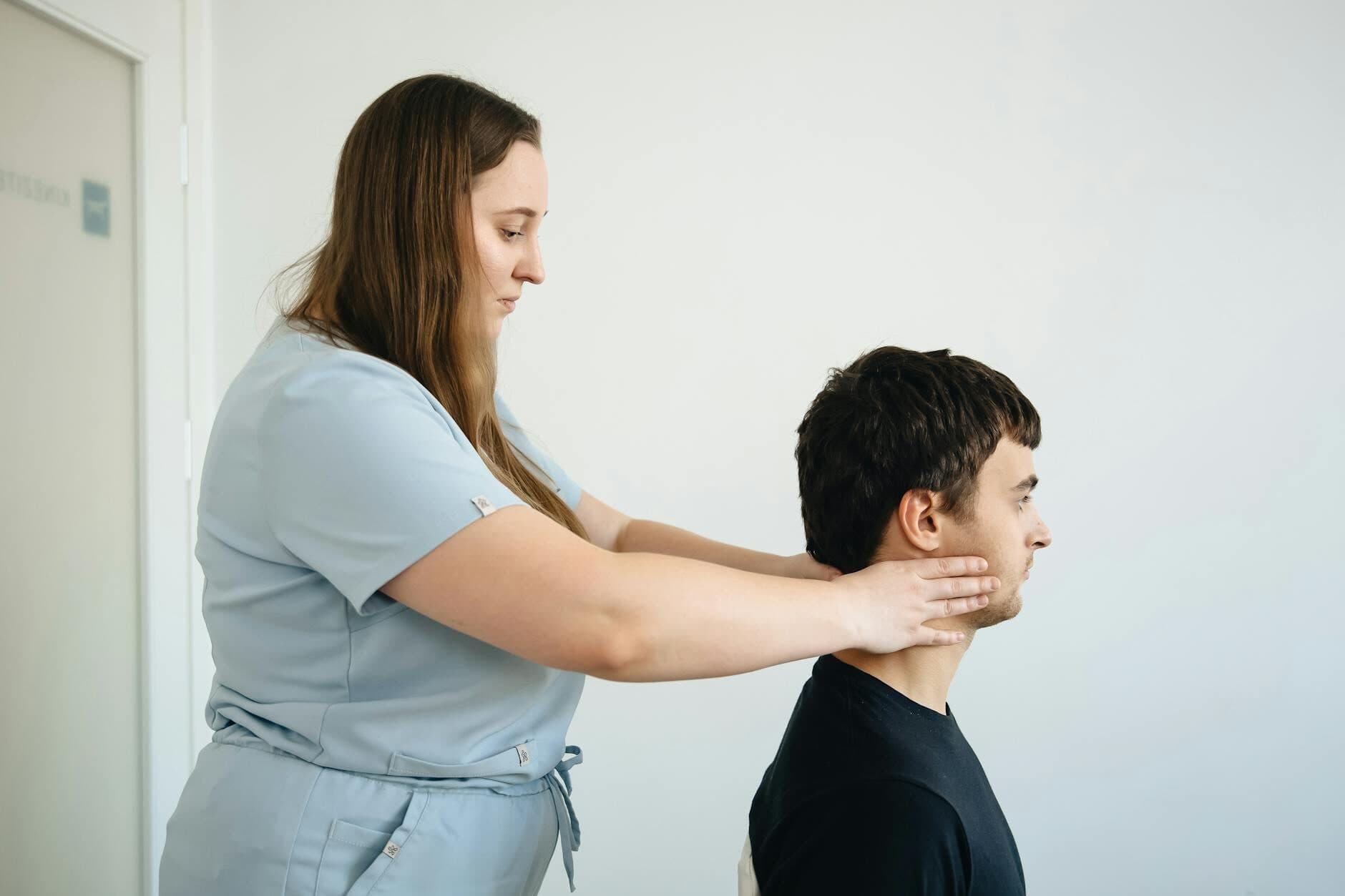
A thorough first consultation involves considerably more than asking where it hurts. We take a detailed history of your headache pattern: onset, frequency, duration, location, quality of pain, associated symptoms, posture at work, sleep quality, and what makes it better or worse. We then assess cervical range of motion, segmental mobility of the upper and mid-cervical spine, muscle length and trigger point status in the neck, jaw, and shoulder girdle, and — where relevant — postural load in sitting and standing.
Jaw mechanics matter more than most people expect. The trigeminal nerve, which is heavily involved in migraine and tension headache, also innervates the temporomandibular joint and the muscles of mastication. If you clench or grind at night, or have jaw clicking or limited mouth opening, this can be a significant contributing factor. This is covered in detail in the guide to TMJ and jaw pain treatment in Amsterdam.
We also consider autonomic nervous system state. Someone in a prolonged stress response carries elevated muscle tone, reduced cervical mobility, and a sensitized central nervous system — all of which lower the headache threshold. This is not abstract: it shows up in measurable clinical findings.
Manual Therapy and Targeted Needling
Where a cervical joint restriction is identified, specific mobilization or manipulation of that segment can produce an immediate and objective change — improved range of motion, reduced referred pain. We do not apply generic massage to the neck and call it done. The input is directed at the primary restriction, and we re-test after each significant intervention to confirm the system has reorganized in a meaningful way.
Within physiotherapy, dry needling with fine Japanese needles into active trigger points in the suboccipital muscles, upper trapezius, or sternocleidomastoid can rapidly reduce the local sensitivity and referred pain these muscles generate. Fine-needle Japanese acupuncture — given by independent, licensed acupuncturists who practise at Alter Physio & Acupuncture, in a more systemically oriented way — can help regulate the autonomic nervous system, reduce central sensitization, and, according to some reviews of the research, may help reduce how often migraines occur for some people when used over a course of treatment.
The choice between these tools — or their combination — follows the clinical reasoning. It is not a protocol; it is a response to what we find in your specific assessment.
Postural and Workstation Factors
Sustained forward head posture increases compressive load on the upper cervical segments and keeps the suboccipital muscles in a shortened, high-tone state. For many people in Amsterdam working long hours at screens, this is the single most important maintaining factor. Workstation height, monitor position, and the absence of regular movement breaks are often more consequential than the treatment itself if they are not addressed. If repetitive strain from desk work is part of your pattern, our RSI treatment page covers the overlapping postural and neurological mechanisms in more depth.
Self-Care and Simple Exercises You Can Start Today
The following strategies are not replacements for a proper clinical assessment, but they are evidence-informed and low-risk. They can meaningfully reduce headache frequency when practiced consistently.
- Upper cervical flexion (chin tuck): Gently draw your chin straight back — creating a slight double chin — and hold for five seconds. Release slowly. Ten repetitions, two to three times daily. This decompresses the upper cervical joints and activates the deep cervical flexors, which are frequently inhibited in people with chronic neck-related headaches.
- Suboccipital self-release: Lie on your back with a rolled towel or two tennis balls in a sock placed at the base of your skull. Allow the weight of your head to rest on the support for two to three minutes. This can reduce suboccipital muscle tone and referred head pain.
- Regular movement breaks: Set a timer for every forty to fifty minutes of screen time. Stand, move your neck gently through its full comfortable range, and take five slow nasal breaths. Maintaining sensory and movement input to the cervical spine throughout the day is more effective than a single long stretching session.
- Nasal diaphragmatic breathing: Three to five minutes of slow, low breathing (inhale four seconds, exhale six seconds) before bed activates the parasympathetic nervous system and can help reduce the autonomic arousal that lowers the migraine threshold.
- Sleep position: Sleeping with a pillow that maintains neutral cervical alignment — not too high, not too flat — reduces the hours per night your cervical structures spend in a mechanically disadvantaged position.
When to Come In
Self-care has clear limits. If your headaches are frequent (more than two episodes per week), if they are worsening over time, if they significantly disrupt work or sleep, or if painkillers are being used more than two to three days per week (medication overuse can itself perpetuate headache cycles), a proper clinical assessment is worthwhile. Similarly, if your headaches began after a whiplash, fall, or other trauma, or if they are accompanied by neurological symptoms such as visual changes, weakness, or significant dizziness, these warrant professional evaluation before assuming a musculoskeletal cause.
New-onset severe headache — particularly one described as “the worst headache of your life” — requires urgent medical attention, not physiotherapy. This article is informational; it does not replace clinical assessment or diagnosis.
Frequently Asked Questions
How many sessions will I need?
This depends entirely on the type, duration, and complexity of your headache pattern. Cervicogenic and tension-type headaches that have a clear musculoskeletal driver often respond within three to six sessions. Chronic migraine with central sensitization and autonomic dysregulation typically requires a longer course of treatment. We will give you a realistic picture after your first appointment.
Can acupuncture really help migraines, or is that overstated?
The evidence is reasonable and growing. Some systematic reviews, including a Cochrane review, suggest a course of acupuncture may reduce migraine frequency for some people, but study quality varies and results differ between individuals. We see acupuncture as a traditional approach that can complement — not replace — medical migraine care.
Do I need a referral from my GP?
No. You can book directly with us. However, if there is any clinical concern that your headaches have a cause that requires medical investigation, we will communicate that clearly and refer you appropriately.
What if I have both migraines and neck pain?
This is extremely common and does not complicate treatment — it often clarifies it. The musculoskeletal component can be addressed directly, and doing so frequently reduces migraine frequency even when the underlying neurological predisposition remains. Treating what is treatable is a sound starting point.
Book Your Headache Assessment in Amsterdam
Recurring headaches and migraines are not something you simply have to manage around. In many cases, there is a specific, identifiable primary restriction — in a joint, a muscle, a nervous system pattern — that, when addressed precisely, changes the picture in a meaningful and measurable way. That is what we look for.
If you are ready to find out what is actually driving your headaches, book an assessment with Hidekazu at Alter Physio & Acupuncture in Amsterdam Zuid. The first session is a full clinical evaluation, not a generic intake. We will tell you what we find, what we think is driving it, and what a realistic treatment plan looks like for you.