
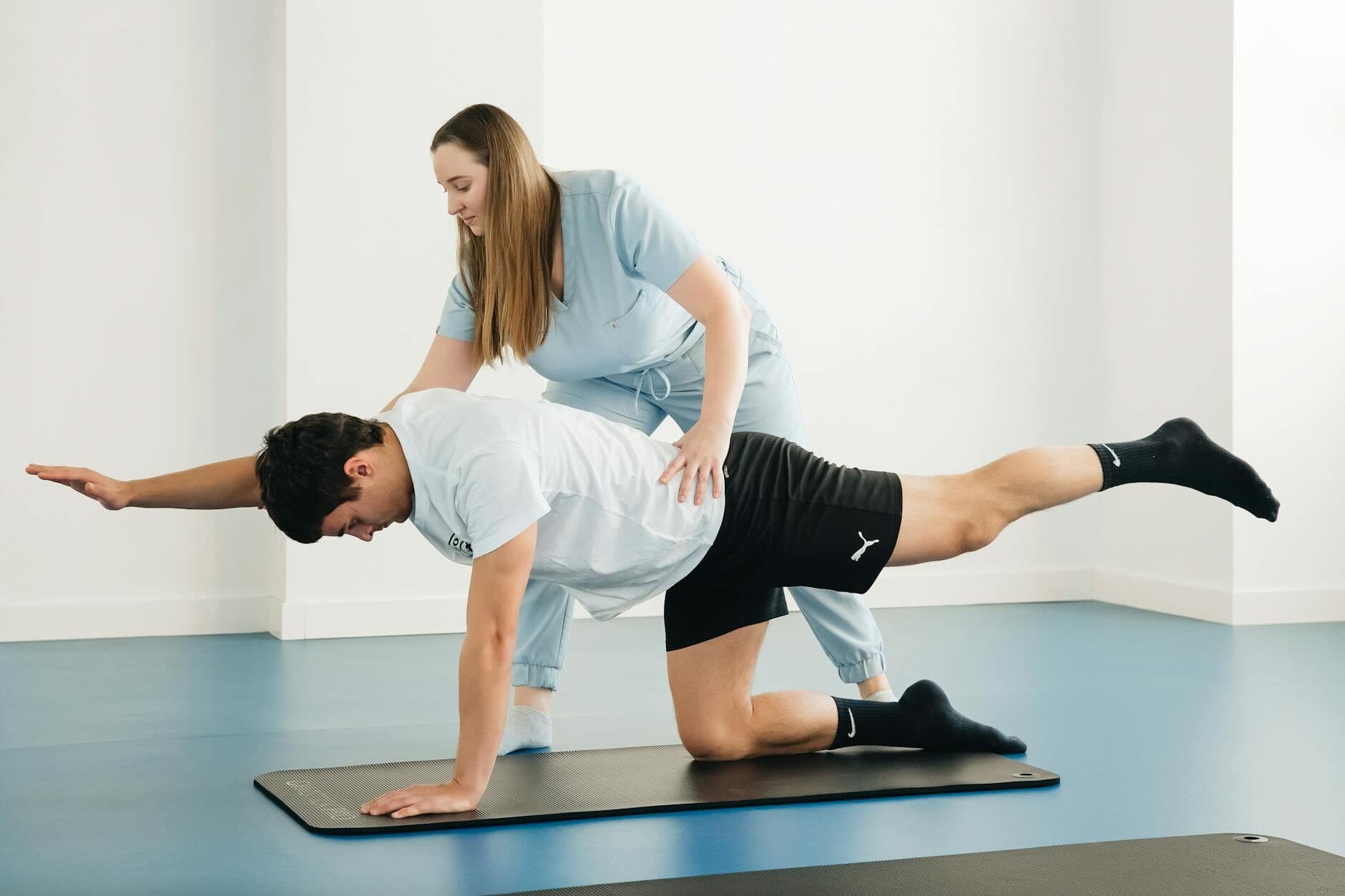
Core Stability Training: The Foundation of a Pain-Free Body
What Is Core Stability — Really?
The “core” is not just your abdominal muscles. That misconception is precisely why so many people train hard, feel stronger in the gym, and still end up with persistent lower back pain, hip instability, or recurring injuries.
The core is better understood as a pressure canister — a muscular cylinder that surrounds the spine from every direction. Its four key components are the transversus abdominis (the deepest abdominal layer), the pelvic floor (the base), the diaphragm (the lid), and the multifidus muscles running along the vertebrae at the back. When these four work together in a coordinated, automatic pattern, they generate intra-abdominal pressure that stiffens the lumbar spine milliseconds before any load arrives — whether that load is a barbell, a heavy shopping bag, or simply reaching overhead.
Core stability training is therefore fundamentally different from doing sit-ups or crunches. Those exercises train the superficial global muscles — the rectus abdominis and the obliques — which are built for power and movement, not for the continuous, low-level anticipatory bracing that protects the spine throughout the day. True core training focuses on controlled, low-load contractions that teach the nervous system to coordinate this canister automatically, so it fires before you are even conscious of needing it.
It is also worth noting that the diaphragm plays a dual role: it is your primary breathing muscle and a structural pillar of core stability. When breathing mechanics are compromised — shallow chest breathing, breath-holding under load, a chronically elevated breathing rate — core stability is compromised too, regardless of how many planks you can hold. If this connection interests you, the deeper reasoning is explored in our article on the pitfalls of traditional core training and the role of diaphragmatic breathing.
Common Causes of Poor Core Stability
Poor core function rarely begins with weakness alone. From a clinical perspective, the more common underlying drivers include:
- A disrupted breathing pattern. Chronic stress, sedentary postures, and habitual shallow breathing reduce diaphragm excursion, shifting the load onto the neck, shoulders, and superficial abdominals.
- Pain inhibition. Even a brief episode of lower back pain can switch off the multifidus and transversus abdominis reflexively. The nervous system is protecting you — but that inhibition often persists long after the pain resolves, leaving the spine under-supported.
- Prolonged sitting and postural loading. Hours at a desk compress the lumbar spine and encourage hip flexor dominance, gradually training the body out of using its deep stabilisers.
- Compensatory movement strategies. People who have learned to brace with their breath held, or who grip excessively with their glutes or obliques, often create rigidity rather than true dynamic stability. The system becomes stiff where it should be responsive.
- Previous injury or surgery. Abdominal surgery, childbirth, hip or knee trauma — any significant event can reorganise the way the nervous system maps and recruits the muscles of the trunk.
Understanding the cause matters because the intervention that resolves a breathing pattern problem is different from the one that resolves post-surgical inhibition, even if both people present with “weak core” and lower back pain.
Why Core Stability Matters Beyond the Gym
- Reduces lower back and pelvic pain by distributing load more evenly across the lumbar spine
- Improves posture and reduces chronic neck and shoulder tension by freeing the superficial muscles from a stabilising role they were never designed for
- Enhances athletic performance by creating a stable platform from which the limbs can generate and transfer force efficiently
- Protects the spine during heavy lifting, sudden movements, and end-of-day fatigue when passive structures are most vulnerable
- Reduces injury risk in runners, cyclists, footballers, and weekend athletes by preventing the compensatory movement patterns that accumulate into overuse injuries
- Supports recovery from pelvic floor dysfunction, diastasis recti, and post-partum rehabilitation
How We Find and Resolve the Root Restriction
At Alter, we approach core instability as a signal — the body’s way of reporting a missing input somewhere in the system. Our assessment does not begin with “how strong is your core?” It begins with: where is the system failing to self-organise, and why?
A typical assessment maps your breathing mechanics at rest and under load, observes how your trunk responds to perturbation and movement challenge, identifies which components of the pressure canister are under-recruited or poorly timed, and checks for joint restrictions or neural tension patterns that may be feeding into the instability. We often use range-of-motion and movement-quality tests before and after a targeted input — whether that is a specific movement cue, a manual technique, or a fine needle placed to reduce local tissue tone — to confirm whether we have identified the primary driver.
This matters because training a muscle that is inhibited due to an unresolved joint restriction, or due to a nervous system still in a protective pattern, can reinforce the compensation rather than resolve it. The smallest effective input that allows the system to reorganise is always the starting point. The tool — whether that is movement re-education, hands-on joint or soft-tissue work, breathwork, or Japanese acupuncture — follows from that reasoning.
A Progressive Core Stability Programme
The following four-level progression follows the clinical logic of moving from isolated activation, through static and dynamic stability, into fully integrated movement. Progress between levels only when the current level feels automatic and effortless — not simply completed.
Level 1 — Activation (Weeks 1–2)
Abdominal bracing: Lie on your back, feet flat on the floor. Gently draw your lower abdomen inward — imagine bracing lightly for a small punch, without sucking in or puffing out. Hold for 10 seconds, breathing normally throughout. Repeat 10 times. This activates the transversus abdominis without recruiting the global muscles. The key cue: your breathing should not change. If you are holding your breath to maintain the contraction, the load is too high.
Level 2 — Static Stability (Weeks 3–4)
Dead bug: Lie on your back, arms pointing to the ceiling, knees bent at 90 degrees. Slowly lower your right arm and left leg simultaneously until they nearly touch the floor, then return. The lower back must remain flat against the floor throughout — place one hand behind your lumbar spine as a feedback monitor. Perform 3 sets of 8 per side. The dead bug trains the core to resist extension loading, the most common failure pattern in people with lower back pain.
Level 3 — Dynamic Stability (Weeks 5–8)
Pallof press: Stand sideways to a resistance band anchor at chest height. Hold the band with both hands at your sternum. Press your arms straight out, resist the band’s rotational pull for two seconds, and return. This is one of the most clinically useful anti-rotation exercises available because it trains the core to resist movement — which is the majority of its real-world job. Perform 3 sets of 10 per side. Ensure the hips remain level and the breath stays relaxed throughout.
Level 4 — Integrated Strength (Ongoing)
Loaded carries: Walk 20 metres holding a moderate weight in one hand (suitcase carry), maintaining an upright posture without leaning toward the load. Switch sides. This integrates core stability with full-body movement under real-world asymmetric loading — closer to carrying shopping or a child than any gym machine. Variations include the farmer’s carry (bilateral) and the waiter’s carry (overhead), each shifting the stability challenge.
Self-Care Between Sessions
Alongside a structured programme, daily habits significantly influence how quickly the nervous system consolidates new stability patterns:
- Prioritise nasal, diaphragmatic breathing throughout your day. Even five minutes of slow, low breathing — expanding the lower ribcage in all directions — can reset an overloaded respiratory pattern and restore the diaphragm’s stabilising contribution. For a deeper look at why this matters, see our guide on diaphragmatic breathing and true core stability.
- Vary your sitting and standing positions regularly. The spine adapts to positions it is held in repeatedly. Movement variability, even small shifts every 20–30 minutes, reduces cumulative load and keeps the stabilising system active.
- Manage your overall stress load. Chronic sympathetic nervous system activation — the physiological state of sustained stress — raises resting muscle tone in the superficial global muscles and reduces the subtle, refined activity of the deep stabilisers. Sleep, recovery, and stress regulation are not optional extras in a rehabilitation plan.
When to Come In
A self-directed programme can be a genuinely useful starting point. But there are situations where a proper clinical assessment is the more efficient — and safer — path:
- You have current or recurring lower back, hip, or pelvic pain that does not settle with rest or general exercise
- You have tried core training before without lasting improvement
- You have a history of abdominal surgery, disc injury, pelvic floor dysfunction, or diastasis recti
- Your pain or instability is affecting your sport, work, or daily movement
- You are unsure whether you are activating the right muscles — or whether you are compensating without knowing it
In these situations, training harder without understanding the root restriction often reinforces the compensation. An assessment first means the programme you follow is matched to your actual system — not a generic template.
Frequently Asked Questions
How long does it take to see results from core stability training?
Research suggests that neuromuscular re-education — teaching the nervous system a new timing and recruitment pattern — can show measurable changes within four to six weeks of consistent, well-loaded practice. Structural adaptation in muscles takes longer. Many people notice improvements in pain and movement confidence within the first two to three weeks, particularly when the root restriction has been identified and addressed from the outset.
Is core stability training safe if I already have lower back pain?
In most cases, yes — but the load, position, and choice of exercise matter significantly. Exercises appropriate for someone with no pain history can aggravate an acute disc irritation or a hypermobile lumbar segment. A baseline assessment allows the programme to be calibrated to what your system can currently accept and adapt to, reducing the risk of a setback.
Do I need to come in regularly, or is one assessment enough?
That depends on the complexity of the presentation. Some people benefit from a single assessment and a clear home programme they follow independently, checking in at intervals. Others need a period of guided sessions to re-establish a movement pattern the nervous system has lost. We will give you an honest recommendation based on what the assessment shows.
Can acupuncture help with core stability?
Japanese acupuncture can be a useful tool when local tissue tone, neural sensitivity, or a persistent protective pattern is preventing the deep stabilisers from activating effectively. It is not used in isolation — it is applied where clinical reasoning suggests it will create the most useful change in the system, allowing movement and exercise to build on that foundation rather than working against it.
If you would like a proper baseline assessment of your core function — one that looks for the root of the restriction rather than just assigning exercises — you are welcome to book a session with Hidekazu. The goal is always the same: a measurable, lasting change, not just a programme to follow.