
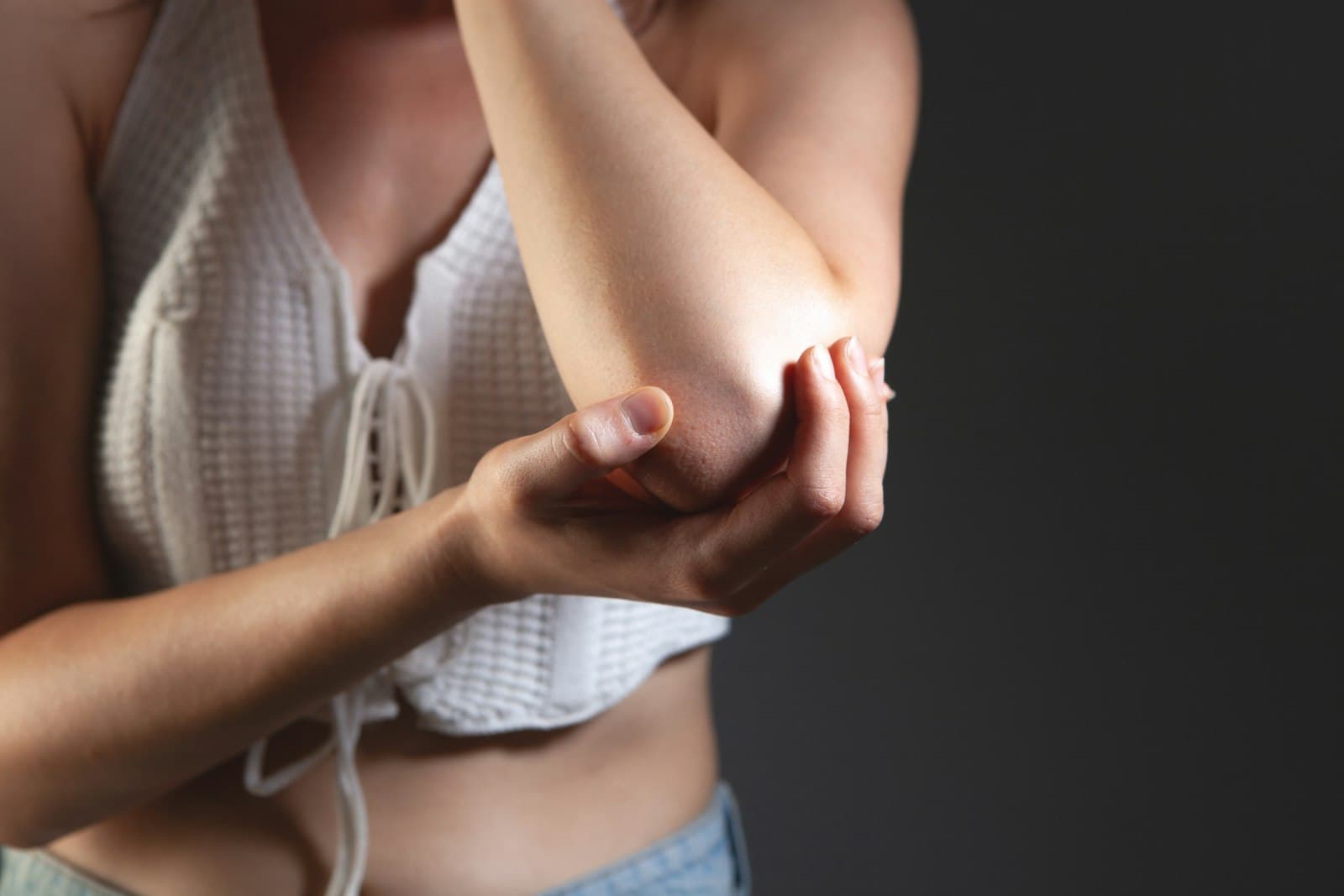
Tennis Elbow in Amsterdam: Why Lateral Elbow Pain Lingers (for Desk Workers and Padel Players)
Does the outside of your elbow hurt when you lift a coffee cup, open a jar, carry a shopping bag home from Albert Heijn or grip your padel racket? Maybe it started after a busy work sprint with a lot of mouse use, or after you picked up padel with friends. You rested it, wore a strap, perhaps had a few physio sessions or an injection, and it still comes back.
You are probably dealing with tennis elbow, known medically as lateral elbow tendinopathy (or lateral epicondylalgia). Despite the name, most people who get it don’t play tennis. This article explains what it is, why it so often lingers, and what an evidence-based recovery plan looks like.
What is tennis elbow?
The muscles that lift your wrist and fingers (the wrist extensors) attach through a shared tendon to a small bony point on the outside of the elbow, the lateral epicondyle. The tendon most often involved belongs to a muscle called extensor carpi radialis brevis.
When that tendon is loaded more than it can adapt to, it becomes sensitive and its structure can change. Studies of these tendons have found little evidence of ongoing classic inflammation, which is why many clinicians now call it a “tendinopathy” rather than “tendinitis”. That difference matters, because it means the goal is to help the tendon tolerate load again, not just to calm down an inflammation.
Who gets it?
Lateral elbow pain is common. In a Finnish population study, about 1 to 3 percent of adults had it at any given time, and it peaked between about 45 and 54 years of age (Shiri et al., 2006). In our clinic in Amsterdam Zuid we see it most often in:
- Office and remote workers who spend long hours with a mouse and keyboard, especially on a laptop without a separate setup
- Padel, tennis and squash players, particularly beginners or people who suddenly play several times a week
- Climbers and gym-goers with a lot of gripping and pulling
- New parents lifting a baby and car seat many times a day
- People doing DIY or moving house (lots of screwdriving, painting and carrying)
Typical symptoms
- Pain on the outside of the elbow, sometimes spreading down the forearm
- Pain when gripping, especially with the palm facing down (lifting a kettle, a laptop bag or a pan)
- Pain when shaking hands, turning a door handle or opening a jar
- Tenderness when you press just in front of the bony point on the outside of the elbow
- Weaker grip than on the other side
Not every outer elbow pain is tennis elbow. Pain with pins and needles, pain that also involves the neck or shoulder, or an elbow that locks or clicks can point to the neck (cervical radiculopathy), a nerve problem at the forearm, or the joint itself. A good assessment checks these possibilities first.
Why it so often keeps coming back
Many people we see have already tried something. Here are the most common reasons tennis elbow lingers.
1. Complete rest, then too much too soon
Resting helps pain settle, but a tendon that is not loaded loses capacity. When you then go back to a full day of mouse work or a two-hour padel session, the load is suddenly too high again. The pattern of “rest, flare-up, rest” can go on for months.
2. Relying on a corticosteroid injection
A cortisone injection often feels great for a few weeks. However, high-quality trials have shown that people who had a corticosteroid injection did better at 6 weeks but worse at one year than those who had physiotherapy or simply waited, with more recurrences (Bisset et al., 2006; Coombes et al., 2013). Injections are not forbidden, but they are rarely the best first choice for long-term recovery.
3. Treating only the elbow
The elbow is the place that hurts, but it is often not the only place that needs work. Grip strength, wrist control, shoulder blade stability and even how you hold a racket or a mouse all change how much load reaches the tendon. At Alter Physio we look at the whole chain, from your fingers up to your neck and shoulder.
4. Ignoring the work setup
If you spend 8 hours a day with your wrist bent back on a mouse, a few exercises in the evening cannot compete. Small changes to your desk setup often make the difference. Our article on RSI treatment in Amsterdam explains how we approach repetitive strain at work.
What actually helps
Good news first: tennis elbow usually gets better. Many cases improve within a year even with little treatment. The aim of treatment is to make recovery faster, more complete and less likely to come back.
Education and load management
We explain which activities load the tendon most (gripping with the palm down, with the wrist bent back) and how to adjust them without stopping your life. That may mean lifting with the palm up, using two hands, a temporary break from padel, or splitting long mouse sessions.
Progressive strengthening
Exercise is the core of treatment. A typical programme starts with exercises that are comfortable, such as holding a light weight with the wrist still (isometric exercise), and builds up to slow lifting and lowering, grip work and finally sport- or work-specific loading. Some discomfort during exercise can be acceptable, as long as it settles by the next day. Your physiotherapist sets the right level and progression.
Hands-on treatment
Manual therapy for the elbow, wrist and neck can reduce pain in the short term and make exercise easier (Bisset et al., 2006). We use it as support, not as the whole treatment.
Brace or strap
A forearm strap (counterforce brace) can reduce pain during activity for some people. It is a tool to keep you active, not a cure.
Work and sport adjustments
For desk workers: mouse position, a vertical mouse or trackpad alternation, wrist position and regular short breaks. For padel and tennis players: grip size, racket weight, playing volume and technique (late hitting and a “wristy” backhand are classic overload patterns). A gradual return plan matters more than any single piece of equipment.
Where Japanese acupuncture fits in
Some patients also choose acupuncture alongside physiotherapy. Research suggests acupuncture may give short-term pain relief in lateral elbow pain, although the evidence is limited and not strong enough to recommend it as a stand-alone treatment (Green et al., Cochrane review, 2002). In our practice, gentle Japanese-style acupuncture with very thin needles is used to calm pain and muscle tension in the forearm, upper arm and shoulder, so that strengthening becomes possible. For deeper or harder-to-reach tissues, we can use ultrasound-guided acupuncture to see exactly where the needle goes.
Quick self-help tips for the first weeks
- Don’t stop moving completely. Reduce the painful activities, but keep the arm active.
- Lift with the palm up and use two hands when carrying heavy things.
- Check your desk. Keep the wrist straight (not bent back) on the mouse, with the forearm supported.
- Take micro-breaks every 30 to 45 minutes to open and close the hand and let the forearm relax. Our guide to office stretches for neck and shoulder tension helps for the rest of the chain.
- Pause padel or tennis for a short period instead of playing through sharp pain, and return gradually.
If the pain has lasted more than 6 weeks, keeps returning, or comes with numbness, weakness or night pain, have it assessed.
Already tried physiotherapy and still have elbow pain?
Many of our patients come to us after treatment elsewhere did not fully solve the problem. Often the exercise programme was never progressed, the work setup was never addressed, or the neck and shoulder were overlooked. If that sounds familiar, read about our second opinion approach.
FAQ
How long does tennis elbow take to heal?
It varies. Many people improve within 6 to 12 months, and a structured exercise programme usually helps you get there faster and with fewer flare-ups. Long-standing cases can take longer.
Should I stop playing padel or tennis?
Usually not forever. A short break or reduced playing time, combined with strengthening and a gradual return plan, works better than playing through sharp pain or stopping completely.
Is a cortisone injection a good idea?
It can reduce pain for a few weeks, but research shows worse results at one year and more recurrences compared with physiotherapy or waiting. Discuss the pros and cons with your GP or specialist.
Do I need a GP referral to see a physiotherapist in the Netherlands?
No. You can book directly with a physiotherapist. Whether your insurance reimburses the treatment depends on your policy, so check with your insurer.
Do you treat in English?
Yes. All our treatments at Alter Physio & Acupuncture in Amsterdam Zuid are available in English, and also in Dutch and Japanese.
Book an assessment
Lateral elbow pain does not have to keep coming back. At Alter Physio & Acupuncture we combine a thorough assessment, a progressive exercise plan, hands-on treatment and, when useful, Japanese acupuncture, so you can get back to work, training and padel with confidence.
Book your appointment online or contact us with any questions.
References:
– Shiri R, et al. Prevalence and determinants of lateral and medial epicondylitis: a population study. Am J Epidemiol. 2006;164(11):1065-1074.
– Bisset L, et al. Mobilisation with movement and exercise, corticosteroid injection, or wait and see for tennis elbow: randomised trial. BMJ. 2006;333(7575):939.
– Coombes BK, et al. Effect of corticosteroid injection, physiotherapy, or both on clinical outcomes in patients with unilateral lateral epicondylalgia: a randomized controlled trial. JAMA. 2013;309(5):461-469.
– Green S, et al. Acupuncture for lateral elbow pain. Cochrane Database Syst Rev. 2002;(1):CD003527.
This article is general information and does not replace an individual assessment.